
Repeating as a Way of Knowing
Motherless BrooklynCounting, touching, and verbal repetition help Lionel organize a chaotic world, but the habits that provide structure also risk becoming compulsions that substitute for understanding.
increasing Bearing strength in each event
 decreasing
Bearing strength in each eventdecreasingSix Burgers and Six Slaps

Six Burgers and Six Slaps
Order in a stakeout
Lionel counts White Castle burgers, inspects each one, and repeats a satisfying tap on the glove compartment. These rituals make a confusing assignment feel briefly manageable.
Control with a cost
The count gives Lionel a private structure but cannot explain why Frank Minna has sent him to the Zendo. Repetition organizes his experience without resolving the case.
The Notebook Ritual

The Notebook Ritual
Observation written down
Lionel records a woman, her glasses, and her key in his notebook. He crosses out one description and replaces it, making the act of note-taking part of the investigation and part of his repetitive ordering.
Details acquire later weight
The notebook also preserves references to Ullman and downtown. A seemingly small ritual of writing becomes evidence that Lionel can return to after Frank Minna dies.
The Fork as Talisman

The Fork as Talisman
A stolen object
As a boy, Lionel steals a fork from Matricardi and Rockaforte’s brownstone, drawn to its shape and finish. He keeps it and later places it among the few possessions in his apartment.
Memory made physical
The fork connects Lionel’s childhood work for Frank Minna to the present investigation. Its value is not practical; it allows him to hold an older, unexplained world in his hands.
A Meal Made Symmetrical
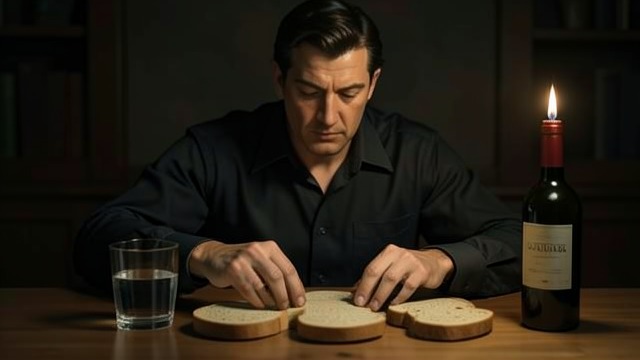
A Meal Made Symmetrical
Ritual against grief
Lionel cuts his sandwich into six equal pieces and arranges food, drink, and candle on a table. He eats only after the arrangement gives sorrow a small, bounded place.
A private mourning rite
The ritual cannot bring Frank Minna back, but it makes Lionel’s grief physically bearable for a time. The scene shows how compulsive order can serve as care as well as confinement.
The Count of Departure

The Count of Departure
Objects cast away
Lionel throws the guns, Minna’s beeper, a cell phone, and finally a shoe into the sea, counting each act. The sequence transforms discarding into a controlled ritual of separation.
A question remains
At five, Lionel stops counting and asks who is counting. The gesture marks a partial break from the objects and obligations that shaped his investigation, without promising that the compulsion is gone.
During the opening stakeout
During the opening stakeout, at six forty-five
Fourteen years before the murder and after
The night Frank Minna dies
At Friendship Head Lighthouse near the ending
